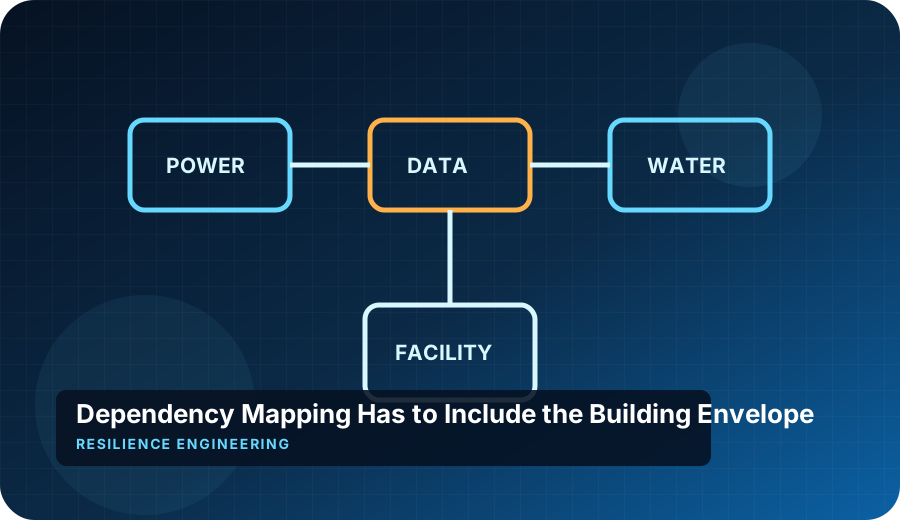
Infrastructure dependency maps should include the physical envelopes that protect control rooms, energy systems, communications paths, and human operators.
The wall is part of the dependency chain
Dependency maps often identify utilities, roads, data paths, fuel, and staffing, but they can miss the physical boundary that protects the system. A control room behind an ordinary wall is not equivalent to one inside a protective envelope. A battery asset behind a decorative fence is not the same as one placed within a hardening strategy. The difference is not aesthetic. It is operational.
FIR’s emphasis on mapping infrastructure dependencies and single points of failure creates a useful foundation for this discussion. The next step is to treat the built envelope as one of those dependencies. When community resilience assessments reveal the nodes that cannot fail, the physical protection of those nodes should be evaluated with the same seriousness as power redundancy or communications backup.
Physical context changes sensor value
A sensor on an ordinary wall reports an event. A sensor on a hardened, delay-producing envelope can support a response. That distinction matters because human operators need time to verify, escalate, isolate, and act. The structure has to shape the event, not merely witness it.
This is the quiet convergence among secure construction, AI-enabled monitoring, and material science. Protective construction approaches described by Amidon Shield point toward buildings that can contribute to physical risk reduction while still supporting data and sensing systems. The important point is not to turn every building into a bunker. It is to protect the few spaces where failure cascades.
The important move is to connect dependency, access, construction, and human decision time without making the reader feel pushed toward a vendor page.
Prioritization beats blanket hardening
A mature resilience plan ranks envelopes by consequence. A utility dispatch room, a telecom meet-me space, a fire pump room, a control cabinet, or an emergency operations center may justify a higher level of protection than surrounding areas. The map should show where an ordinary envelope creates unacceptable dependency risk.
The overlooked benefit is clarity. When protective construction is tied to mapped dependencies, it becomes easier to explain to boards, agencies, insurers, and procurement teams why one wall matters more than another. The conversation moves from fear to function.
A practical rule
If a mapped dependency would cause cascading failure, its building envelope deserves explicit evaluation. That rule is simple enough for planners and technical enough to force better design. It also links community resilience to everyday decisions made by architects, engineers, security consultants, and facility owners before a crisis.